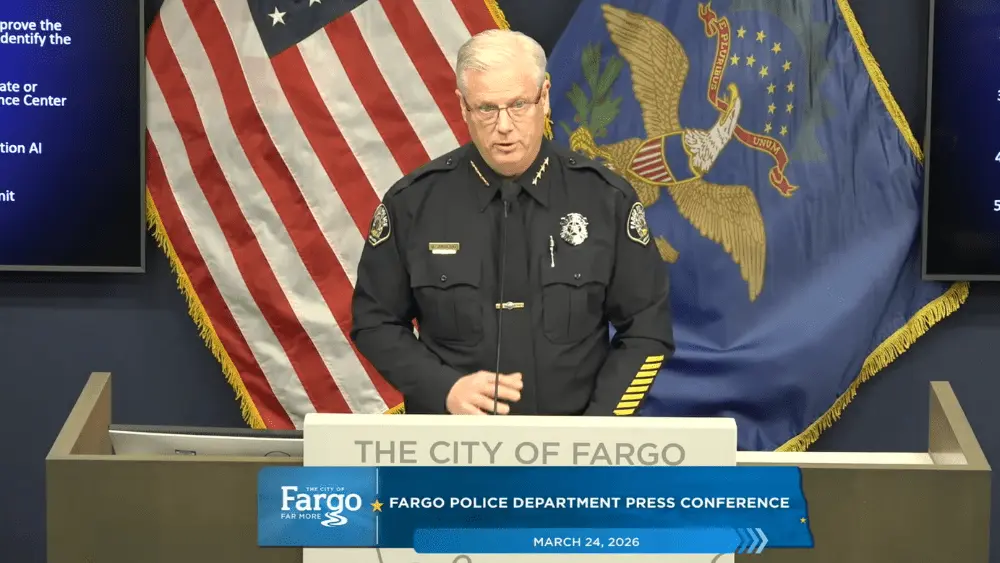
FARGO, N.D. – Fargo Police say changes are being made when it comes to artificial intelligence being used for police work within the city.
The department held a press conference Tuesday afternoon at the Fargo Police Department to discuss the use of the technology and how it relates to the case of Angela Lipps, a woman from Tennessee who was jailed in Fargo in connection to a fraud case that was linked to her using facial recognition.
Fargo Police Chief David Zibolski said the department does not have any equipment that does facial recognition artificial intelligence – they rely on other entities, such as the North Dakota State and Local Intelligence Center, or NDSLIC.
Zibolski said he was not aware, nor were any others in his executive level, that West Fargo had any type of AI facial recognition systems.
“They, through their AI system, made that identification of Ms. Lipps and forwarded that information,” he said. “It’s not an identification, it’s a potential suspect, but they forwarded that information to our detectives, who then assumed, wrongly, that they had also sent in the surveillance photos with that photo ID.”
The photo hit on Lipps ‘as a potential person.’
“That ID used also was assumed to be the same one used in our incident on May 9th,” Ziboski said.
After finding out West Fargo had not sent surveillance photos, the Fargo Police Department worked to ensure all of their surveillance photos were sent to NDSLIC.
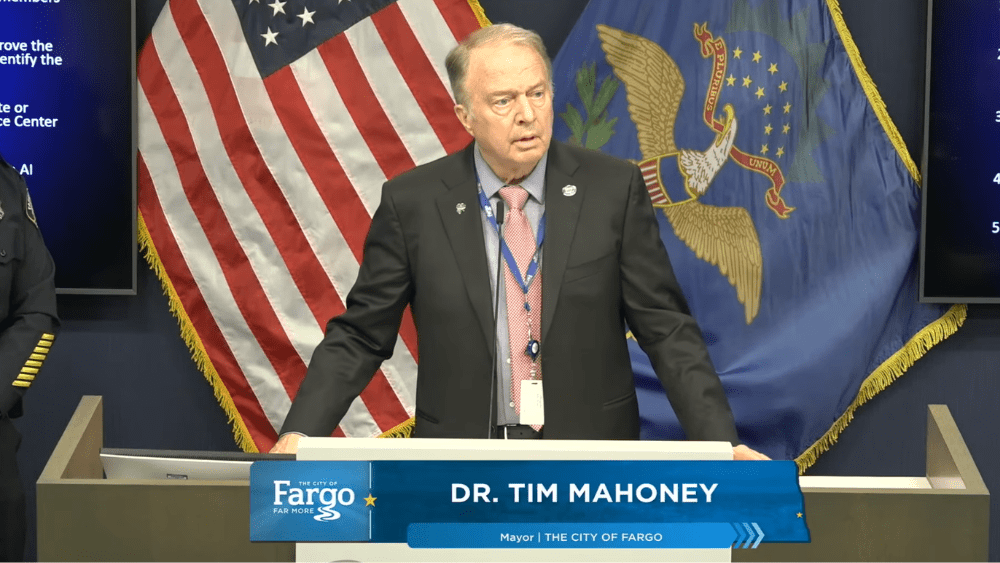
Mayor Dr. Tim Mahoney addressed the chief’s handling of the issue.
“When Chief found some errors that were made in this area of where we got our facial recognition and how that worked, we immediately addressed it,” he said. “
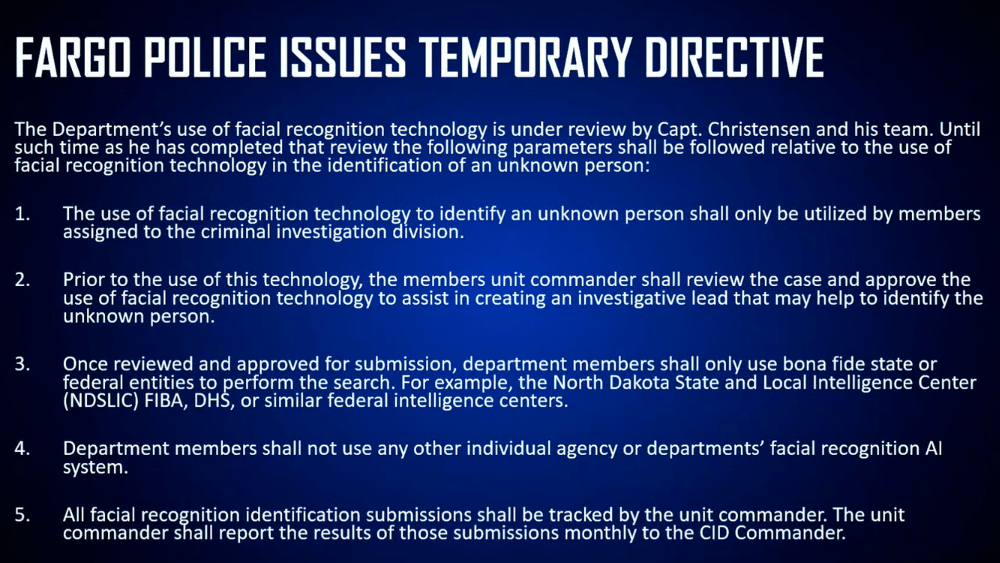
In response, Zibolski issued an immediate temporary directive on March 20.
“The use of facial recognition technology to identify an unknown person shall only be utilized by members of the Criminal Investigation Division,” he said. “So our patrol officers are doing this and have not been doing this. Prior to the use of technology, the member’s unit commander shall review the case and approve the use of facial recognition technology, meaning the submission to NDSLIC, to assist us in the investigative lead that may help identify that unknown person.”
The new directive only allows submission to state or federal entities, including intelligence centers, to perform searches. This means they will no longer use West Fargo’s system.
“We will no longer be sending or utilizing information received from West Fargo’s AI system because simply it’s their own system,” Zibolski said. “We don’t know how it’s run or how it’s overseen.”
The chief said he is ‘not faulting West Fargo for having their own system.’
“But certainly had we known that, we would not have allowed that to be part of this investigation,” he said.
Zibolski said he’s also working to update standard operating procedures and policies specific to facial recognition.
“We will be providing some additional training to our staff through NDSLIC relative to facial recognition,” he said.
Fargo Police does not plan to purchase facial recognition technology.
“I don’t see any good reason to do that. It’s not only pricey, but it requires a level of expertise,” the chief said.
ZIbolski also addressed a communication gap with Cass County that happened after Lipps was arrested in Tennessee and the time in December when police interviewed her for the first time.
“We would have liked to have known that so that we could provide or conduct any additional interviews, follow-ups, et cetera, or at least try to arrange those,” he said. “We did complete that once within two weeks of being notified, figuring out that she was in the county jail.”
Zibolski said he’s working with Cass County, the state’s attorney’s office and the jail to improve communications.
“There’s not an easy mechanism for them to notify us if someone arrested on our felony warrant is into custody, so we’re looking at other options,” he said.
In the meantime, Investigations Division Commander Captain Matt Christensen has his officers reviewing the booking roster daily ‘to see if they recognize any names from open cases or warrants that they might have.’
“We’ll be looking for other ways to make that a little more efficient as well,” Zibolski said.
When asked if he’s planning to apologize to Lipps, he addressed the current status.
“We still don’t know who’s involved and who’s not involved,” Zibolski said. “We’re going to have to whittle through all of this kind of vast network of people and who’s involved. You know, you could have, this is a large conspiratorial type of operation in which many people are involved.”