FARGO, N.D. – Fargo Mayor Dr. Tim Mahoney shared information during Monday’s City Commission meeting about the city’s $1.37 billion debt as it’s being talked about by mayor and City Commission candidates.
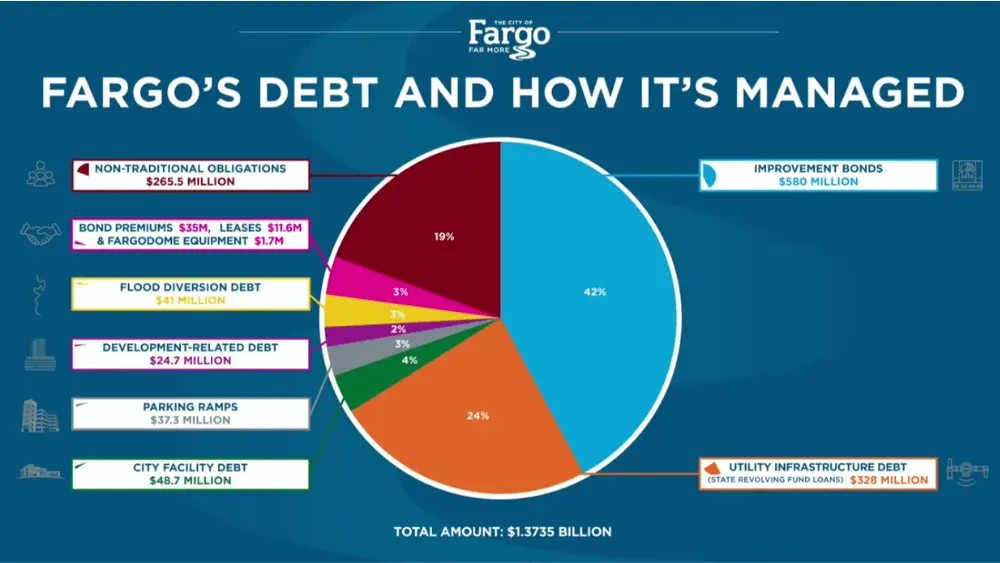
$580 million is in improvement bonds. Property owners are assessed special assessments for street repairs and infrastructure for new development. They are paid for benefiting property owners. Mahoney said the city gets more favorable bond rating so interest rates are lower. The city was going to go to a 50% cost share for special assessments, but it pays 75 to 80%
“That’s better than any place in North Dakota, so we treat our people very well,” Mahoney said.
$328 million in debt is for utility infrastructure called state revolving fund loans. That includes wastewater plant expansion and improvements and utility and solid waste upgrades. Most of the debt has a 2% interest on a 30-year loan It’s paid for by the 1% infrastructure sales tax. Voters will decide if that’s renewed.
$265.5 million in for non-traditional obligation debt including employee leave and pensions. Mahoney said $9 million has been added to revenue which will lead to a reserve fund being made.
“With the market doing so well, we’re decreasing the amount of obligations we have because the money grows in our pension fund,” Mahoney said.
There is $48.7 million in city facility debt which includes city hall, fire stations, police headquarters, public health building and other essential facilities.
There’s $41 million in debt for the diversion which Mahoney will be paid back by the Fargo-Moorhead Diversion Authority using sales tax revenue.
There’s $37.5 million in debt for parking ramps which will be paid for by TIFF revenues of $1 million a year and those paying for parking.
There’s $35 million in bond premiums debt $11.6 million in leases and $1.7 million in Fargodome equipment.
Lastly, there’s $24.7 in development-related debt. That’s related to projects where developers and TIFF revenue pays in. Mahoney says that’s set to pay for themselves.
“I beg you to look at this a little bit different, because if you really look at it, in totality for what we have in debt load, we have $1.37 billion [in debt] and we’re going to take special assessments because those are owned by the residents or corporations that own property and we’re going to take the diversion off, really our debt load is $752.7 million,” Mahoney said.
Mahoney reminded the public the Commission took part in an audit done by Eide Bailly in August 2025 that said the city received an unmodified clean opinion which is the best possible result.
Mahoney said he has heard of people wanting forensic accounting which the mayor said usually uncovers fraud.
“Any one of the commissioners who talks about forensic accounting should report it to [City Administrator Michael Redlinger] and we should look into whatever department you think is doing something wrong,” Mahoney said.
On WDAY Radio and during mayoral debates, City Commissioner Dave Piepkorn said the city has 15 employees as part of its communications department which he believes is too much. During the Commission meeting, Mahoney said the department only has six employees and it went from a $2 million budget to $486,000.
“When people talk about a bloated department, we have core services for our department that’s doing an excellent job. I think all six of those members should be congratulated for all the great work they do,” Mahoney said.
Piepkorn asked Mahoney if commissioners could comment on his presentation.
“We’re done with liaison reports,” Mahoney said.
Later on in the meeting, Piepkorn said with the city’s new land development code, the $580 million for improvement bonds, the special assessment system will be reformed.
“The taxpayers are the bank financing infrastructure for new developments. That’s a risk we can no longer take. That’s the reason for the Moody’s downgrade in our credit. What that needs to do is to be moved to the responsibility of the developer. When you buy your house, you pay for the infrastructure in that new development,” Piepkorn said.
“I’m not going to debate back-and-forth,” Mahoney said.